Agentforce vs Einstein Copilot: What Is Actually Different
If you are searching for agentforce vs einstein copilot, you are probably trying to answer one practical question:
Did Salesforce actually ship something new, or did they rename the AI assistant again?
Fair question.
Salesforce has a habit of turning product naming into an endurance sport. Einstein, Einstein GPT, Copilot, Prompt Builder, Copilot Studio, Agentforce, Agent Builder, Atlas, Data Cloud, trust layer — it gets noisy fast.
Here is the blunt version:
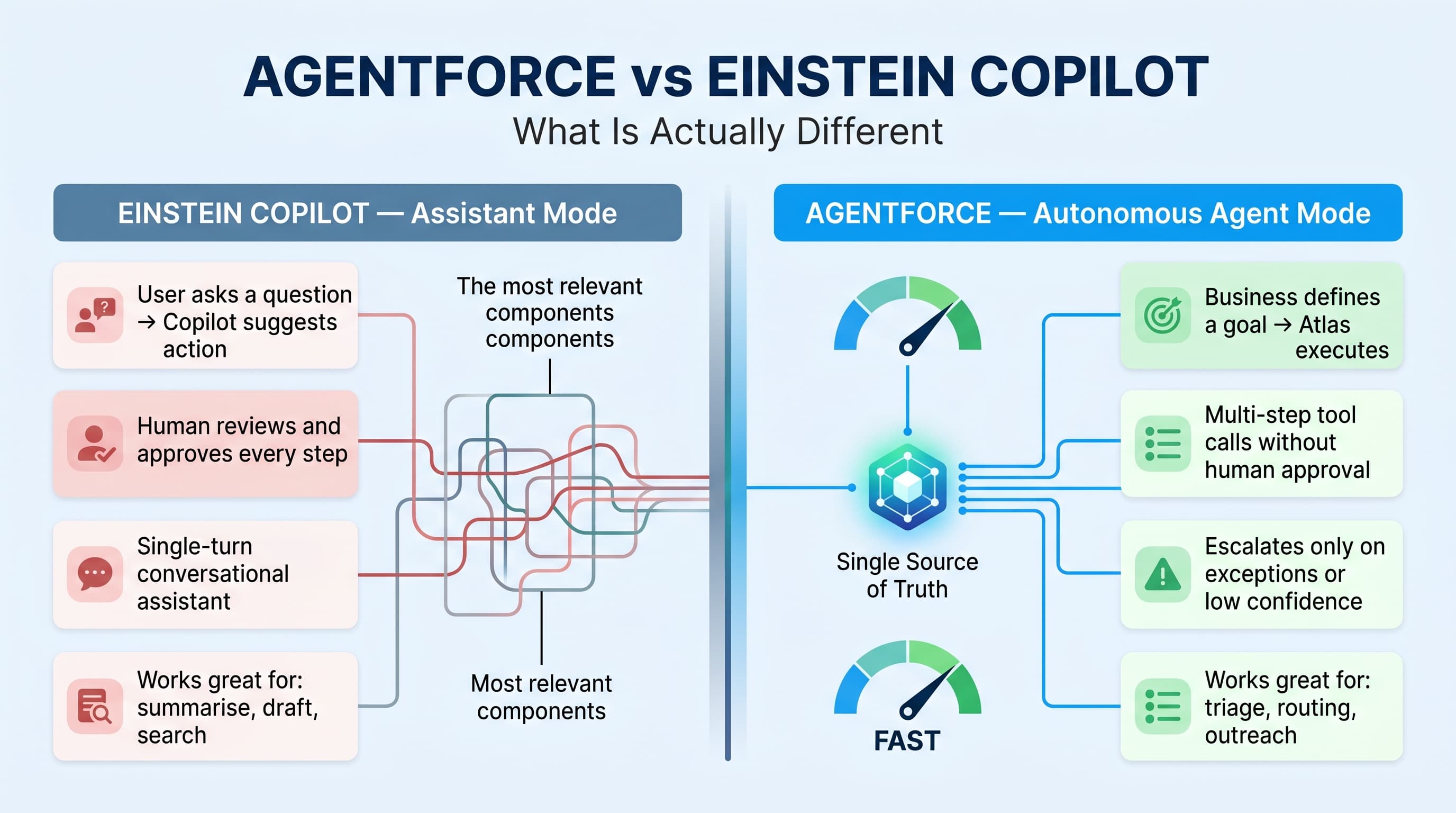
Einstein Copilot was primarily an AI assistant experience inside Salesforce. Agentforce is Salesforce’s agent platform for building role-based, action-taking, semi-autonomous AI workers.
That distinction matters if you are designing architecture, estimating licenses, integrating with enterprise systems, or deciding whether AI belongs in a sales console, service channel, Slack workflow, or back-office automation.
I have built Salesforce automation in enterprise orgs for years, and my opinion is simple: most teams should stop asking, “Which AI product should we buy?” and start asking, “What decisions and actions are we willing to let an AI system perform?”
That answer determines whether you need Copilot-style assistance or Agentforce-style agency.
The short version
Einstein Copilot was about helping a user do work.
Agentforce is about assigning work to an AI agent.
That sounds subtle, but architecturally it is a big shift.
With Einstein Copilot, the mental model was:
- User opens Salesforce
- User asks a question
- Copilot uses CRM context
- Copilot suggests or performs an action
- User remains the main operator
With Agentforce, the mental model becomes:
- Business defines a job
- Agent is given topics, instructions, actions, and data access
- Agent interacts through a channel
- Agent reasons over the task
- Agent executes approved actions
- Human is pulled in when confidence, policy, or risk requires it
Here’s the unpopular take: Agentforce is not valuable because it chats. It is valuable only when it can safely do useful work.
If all you want is a prettier chatbot that summarizes Account records, you do not need an agent strategy. You need better UX and maybe a prompt template.
What Einstein Copilot was designed to do
Einstein Copilot was Salesforce’s conversational assistant embedded in the flow of CRM work.
Typical use cases looked like this:
- Summarize an Account
- Draft an email
- Create a follow-up task
- Answer questions from Salesforce records
- Help a sales rep prep for a meeting
- Update fields based on user instructions
- Generate service replies from case context
The core value was user productivity.
A sales rep could ask, “What changed on this opportunity since last week?” A service agent could ask, “Draft a response using the latest case notes.” A manager could ask, “Which renewals are at risk this quarter?”
That is useful. I do not dismiss it.
But it is still mostly assistant-oriented. The human initiates. The human supervises. The human is the center of the workflow.
Copilot-style systems work best when:
- The task starts from a user prompt
- The user is already inside Salesforce
- The output is text-heavy or decision-support oriented
- Actions are simple and bounded
- Approval is expected before anything meaningful happens
That is not a bad model. In regulated enterprises, it is often the right model.
What Agentforce is designed to do
Agentforce moves the conversation from “assistant” to “agent.”
An agent is not just a chat UI. An agent has:
- A role
- A goal
- Topics it can handle
- Instructions it must follow
- Actions it can execute
- Data it can access
- Guardrails around what it cannot do
- Channels where it operates
- Escalation paths when it gets stuck
That is the important part.
Agentforce is Salesforce saying: “Instead of giving every user a generic AI helper, let’s build specialized agents that can perform business jobs.”
Examples:
- Sales development agent that qualifies inbound leads
- Service agent that resolves common support issues
- Commerce agent that helps with order status and returns
- Employee agent that answers HR or IT questions
- Field service agent that triages work orders
- Partner agent that assists with deal registration
The agent model changes the architecture.
You are no longer just grounding a prompt in a record page. You are designing a controlled operating environment where AI can reason, call actions, touch data, and potentially communicate with customers or employees.
That requires more discipline.
Quick comparison: Einstein Copilot vs Agentforce
| Dimension | Einstein Copilot (CRM) | Agentforce Agent |
|---|---|---|
| Primary model | User asks → AI helps | Business assigns → AI acts |
| Human involvement | Human in the loop | Human on exception |
| Trigger | User-initiated prompt | Event, channel, or schedule |
| Execution | Single-turn or guided action | Multi-step reasoning + tool calls |
| Actions | Pre-defined invocables | Configured action set (Apex, Flow, API) |
| Best for | Drafting, summarizing, lookup | Triage, routing, qualification, automation |
| Risk profile | Response quality | Action quality + blast radius |
| Who builds it | Admins + prompt engineers | Architects + developers + security |
| Governance | Prompt templates, grounding | Topics, guardrails, escalation policies |
| Data Cloud benefit | Better grounding for answers | Better context for decisions |
Use this as a starting point for stakeholder conversations. The nuance comes in the next section.
The actual differences that matter
1. User assistance vs delegated work
Einstein Copilot helps a human perform a task.
Agentforce can be assigned a task.
That is the biggest difference.
For example, in a Copilot model, a sales rep may ask:
“Summarize this account and draft a renewal email.”
In an Agentforce model, a renewal agent may automatically identify accounts with usage drops, generate a risk summary, create a retention task, notify the CSM, and prepare an email draft.
The second model is not just conversational. It is operational.
2. Prompting vs agent design
Copilot implementations often focused on prompts, grounding, and user-facing actions.
Agentforce requires more structured design:
- What topics does this agent own?
- What topics should it refuse?
- What actions can it execute?
- What inputs are required?
- What data sources are trusted?
- When must it escalate?
- What audit trail is required?
- What happens when the model is wrong?
This is where enterprise teams either succeed or create a demo that never reaches production.
A prompt is not an operating model.
3. Single assistant vs multiple role-based agents
Einstein Copilot felt like a general assistant layered into Salesforce.
Agentforce encourages specialized agents.
That matters because enterprise work is not generic. A support triage agent and an enterprise sales agent should not share the same instructions, permissions, actions, or escalation policy.
In real orgs, generic AI becomes dangerous quickly. It either has too much access or too little usefulness.
Role-based agents are easier to govern.
4. Human-in-the-loop vs human-on-exception
Copilot usually assumes the user is actively involved.
Agentforce pushes toward human-on-exception.
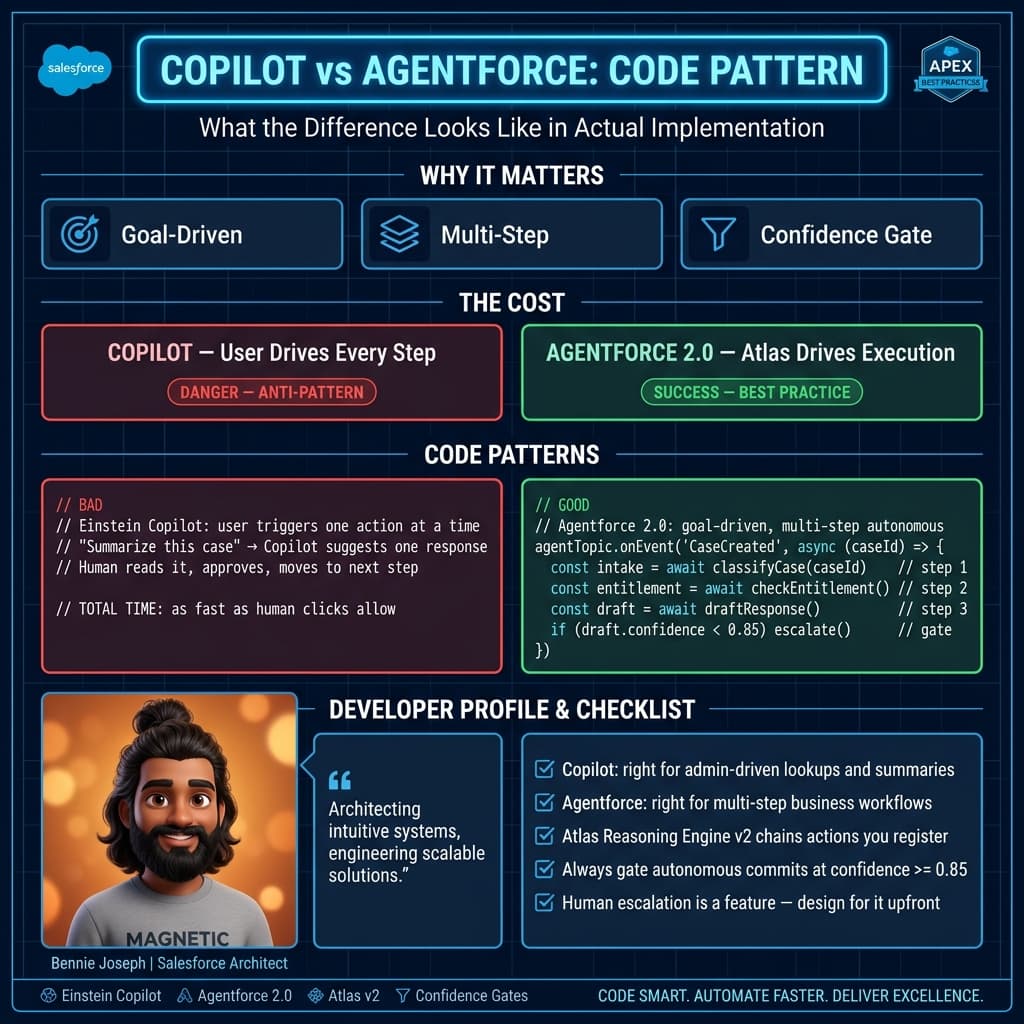
That means the agent can proceed until it hits a boundary:
- Low confidence
- Missing required data
- Policy restriction
- Customer sentiment issue
- Financial threshold
- Legal/compliance trigger
- Integration failure
This is the model I prefer for enterprise automation. Humans should not babysit every step. They should review exceptions and decisions that matter.
5. UX feature vs platform capability
Einstein Copilot was experienced mainly as a productivity layer.
Agentforce is closer to a platform capability that includes:
- Agent configuration
- Topics
- Instructions
- Actions
- Data grounding
- Reasoning
- Channel deployment
- Trust and guardrails
- Integration with Salesforce automation
This changes who needs to be involved.
Copilot could often be piloted by admins, enablement teams, and business stakeholders.
Agentforce needs architects, security, integration owners, data teams, process owners, and support operations. If the agent can create records, change statuses, invoke Apex, or call external systems, it is no longer “just AI.”
It is enterprise automation with a probabilistic reasoning layer.
A real enterprise example
I worked on a Salesforce program for a large B2B organization with a heavy service operation. Thousands of cases came in every week across email, portal, and phone channels. The service team had solid Service Cloud fundamentals: assignment rules, queues, macros, entitlements, milestones, and knowledge.
But the pain was still obvious.
Tier 1 agents spent too much time doing repetitive triage:
- Is the customer active?
- What product line is this about?
- Is there an open outage?
- Has this customer logged similar cases recently?
- Does the entitlement cover priority support?
- Should this go to billing, technical support, or account management?
- Is this customer high-risk?
A Copilot-style assistant could help an agent summarize a case or draft a response. Useful, but not transformational.
The better design was an agent-style workflow:
- Read the incoming case
- Classify the issue
- Check account status and entitlement
- Search recent cases and known incidents
- Recommend a routing queue
- Create an internal summary
- Escalate only if the case involved legal, security, executive visibility, or high-value accounts
- Let a human approve responses for sensitive categories
That is the difference.
The business did not need an AI assistant sitting beside every service rep. They needed an AI triage agent that could reduce queue noise before humans got involved.
But we did not let the AI directly do everything. We exposed narrow, deterministic actions. The agent could call approved business functions. It could not freestyle updates across the org.
That is how I recommend building Agentforce actions: small, auditable, permission-aware, and boring.
Boring is good when automation touches customers.
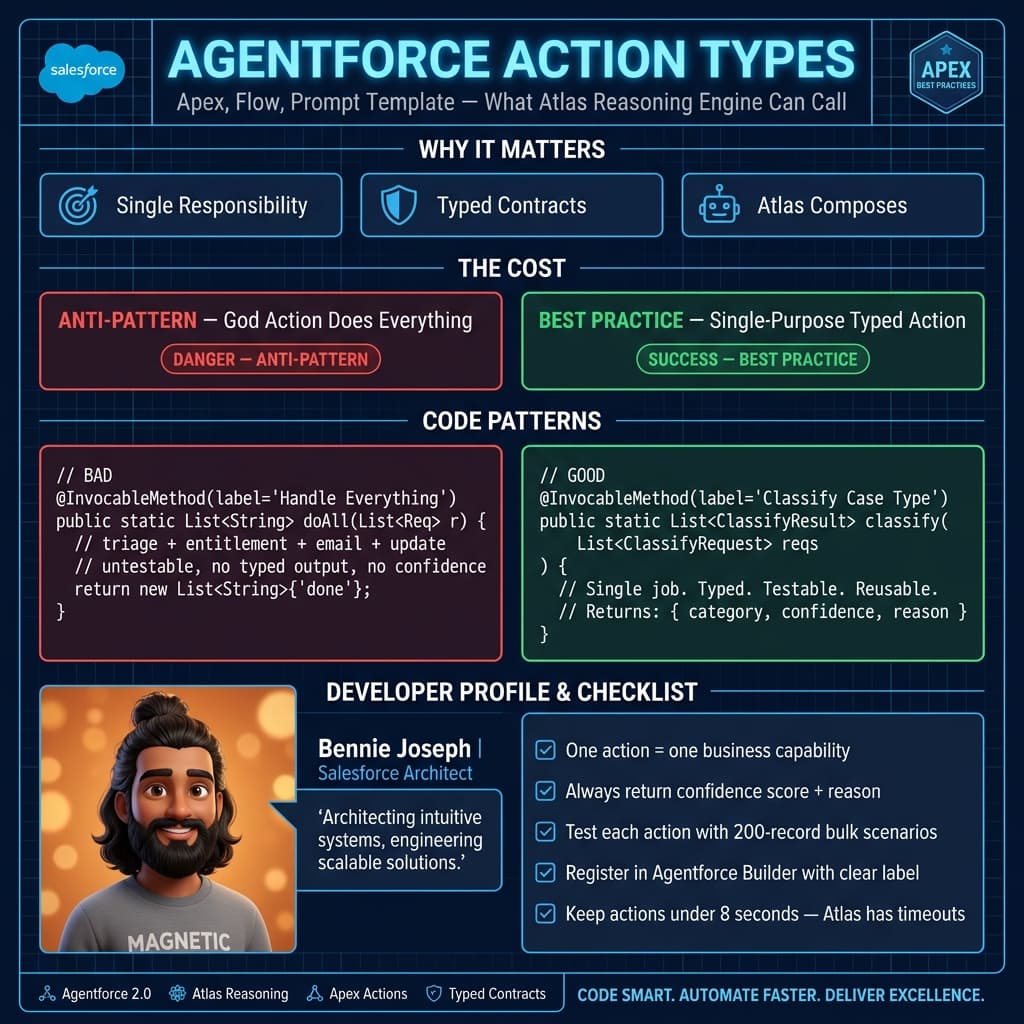
Example: exposing a safe Apex action
Whether you are building Copilot actions or Agentforce actions, the pattern is similar: give AI a controlled tool, not unlimited access.
Here is a simplified Apex example of an invocable action that evaluates an Account’s support risk and creates a review task. This is the type of operation I would rather expose to an agent than let it directly manipulate five unrelated objects from generated instructions.
public with sharing class AccountSupportRiskAction {
    public class Request {
        @InvocableVariable(required=true)
        public Id accountId;

        @InvocableVariable(required=false)
        public String reason;
    }

    public class Response {
        @InvocableVariable
        public Id taskId;

        @InvocableVariable
        public String riskLevel;

        @InvocableVariable
        public String message;
    }

    @InvocableMethod(
        label='Create Account Support Risk Review'
        description='Creates a task for the account owner when support risk indicators require human review.'
    )
    public static List<Response> createRiskReview(List<Request> requests) {
        List<Response> responses = new List<Response>();

        Set<Id> accountIds = new Set<Id>();
        for (Request req : requests) {
            if (req != null && req.accountId != null) {
                accountIds.add(req.accountId);
            }
        }

        Map<Id, Account> accounts = new Map<Id, Account>([
            SELECT Id, Name, OwnerId, AnnualRevenue, NumberOfEmployees
            FROM Account
            WHERE Id IN :accountIds
        ]);

        List<Task> tasksToInsert = new List<Task>();

        for (Request req : requests) {
            Response res = new Response();

            if (req == null || req.accountId == null || !accounts.containsKey(req.accountId)) {
                res.riskLevel = 'Unknown';
                res.message = 'Account was not found or request was invalid.';
                responses.add(res);
                continue;
            }

            Account acct = accounts.get(req.accountId);

            String riskLevel = 'Medium';
            if (acct.AnnualRevenue != null && acct.AnnualRevenue > 50000000) {
                riskLevel = 'High';
            }

            Task reviewTask = new Task(
                OwnerId = acct.OwnerId,
                WhatId = acct.Id,
                Subject = 'Review support risk for ' + acct.Name,
                Status = 'Not Started',
                Priority = riskLevel == 'High' ? 'High' : 'Normal',
                ActivityDate = Date.today().addDays(1),
                Description = 'AI agent requested review. Reason: ' +
                    String.valueOf(req.reason).left(1000)
            );

            tasksToInsert.add(reviewTask);
            res.riskLevel = riskLevel;
            responses.add(res);
        }

        if (!tasksToInsert.isEmpty()) {
            insert tasksToInsert;
        }

        Integer taskIndex = 0;
        for (Response res : responses) {
            if (res.message == null && taskIndex < tasksToInsert.size()) {
                res.taskId = tasksToInsert[taskIndex].Id;
                res.message = 'Support risk review task created.';
                taskIndex++;
            }
        }

        return responses;
    }
}
This is not fancy. That is the point.
The action has a clear purpose. It accepts minimal input. It performs predictable logic. It creates a record humans already understand: a Task. It does not give the agent broad authority to update Account fields, change entitlement status, or email the customer.
In an Agentforce implementation, I want dozens of these narrow tools, not one giant “do anything” action.
Where Data Cloud fits
Both Copilot-style and Agentforce-style experiences get better when the AI has useful context.
But Agentforce increases the pressure on your data architecture.
If an assistant gives a bad summary, the user may catch it. If an agent makes a bad decision because your customer profile is stale, that mistake may become an operational event.
For enterprise Salesforce orgs, this is where Data Cloud becomes relevant:
- Unified customer profile
- Engagement history
- Product usage signals
- Web or commerce activity
- Support interactions
- Segments and calculated insights
- External data activation
But here is another unpopular take: Data Cloud does not fix bad data ownership.
If nobody owns the definition of “active customer,” “at-risk account,” or “qualified lead,” your agent will inherit the confusion. AI does not magically resolve business ambiguity. It amplifies it.
Before building agents, define your business signals.
Security and trust are not optional
The risk profile is different between Einstein Copilot and Agentforce.
Copilot risk is usually around response quality, inappropriate suggestions, and data visibility.
Agentforce risk includes all of that plus action risk:
- Did it create the wrong record?
- Did it route the case incorrectly?
- Did it expose data in the wrong channel?
- Did it trigger an integration?
- Did it communicate something inaccurate to a customer?
- Did it bypass an approval process?
This is why I prefer designing agents around existing Salesforce security and automation boundaries:
- Permission sets
- Sharing rules
- Named credentials
- Flow entry criteria
- Apex service classes
- Platform events
- Approval processes
- Audit fields
- Field-level security
- Restriction rules where needed
Do not create a privileged AI super-user because the demo looks better. That is how you turn a productivity project into a governance incident.
When I would use Einstein Copilot-style patterns
Even if Agentforce is the newer and broader platform direction, Copilot-style patterns still make sense.
I would use assistant-style AI when:
- A human needs to stay in control
- The task is exploratory
- The output is mostly text
- The process varies heavily by user judgment
- The risk of autonomous execution is too high
- Adoption depends on meeting users inside their daily workflow
Good examples:
- Opportunity summaries
- Call prep
- Email drafting
- Case response drafting
- Knowledge article suggestions
- Manager coaching prompts
- Pipeline inspection assistance
These are valuable because they reduce cognitive load.
Not every AI use case needs autonomy.
When I would use Agentforce
I would use Agentforce when the business process has repeatable work that can be delegated safely.
Good examples:
- Lead qualification
- Case triage
- Appointment scheduling
- Order status handling
- Renewal risk monitoring
- Internal IT helpdesk requests
- Partner onboarding guidance
- Proactive customer success outreach
The key phrase is delegated safely.
If you cannot define the agent’s job in plain English, you are not ready to build it. If you cannot define what the agent is forbidden to do, you are definitely not ready.
Decision matrix: which one fits your use case
Use this to cut through the sales pitch:
| Use Case | Recommendation | Why |
|---|---|---|
| Sales rep drafting renewal email | Copilot pattern | User-driven, judgment-heavy |
| Summarize account before a call | Copilot pattern | Exploratory, assistant role |
| Qualify and score 500 inbound leads daily | Agentforce | Repeatable, high-volume, delegatable |
| Route service cases before agents see them | Agentforce | Structured criteria, measurable outcomes |
| Help agent write case resolution note | Copilot pattern | Human stays in loop |
| Proactively notify CSMs of churn signals | Agentforce | Event-driven, no user in loop |
| Answer order status in Slack or portal | Agentforce | Channel-based, deterministic queries |
| Manager reviewing pipeline health | Copilot pattern | Analytical, exploratory, user-led |
| Onboarding partner through a structured flow | Agentforce | Task-based, automated steps |
| Compliance review with audit requirements | Neither alone — pair with Approval Process | Risk too high for autonomous decisions |
The pattern: if a human would routinely do the same steps in the same order, it is an Agentforce candidate. If the task is exploratory or judgment-heavy, Copilot patterns are safer.
How I explain it to executives
When executives ask me about agentforce vs einstein copilot, I avoid product jargon.
I explain it like this:
Einstein Copilot is like giving every employee a smart assistant. Agentforce is like hiring digital workers for specific jobs.
Then I ask three questions:
- What work should the AI do?
- What systems does it need to touch?
- What decisions require a human?
Those questions cut through the hype.
If the answer is “help reps write better emails,” start with assistant patterns.
If the answer is “handle 40% of routine service requests before they hit the queue,” you are talking about agents.
My architecture recommendation
Start with one high-volume, low-risk process.
Do not begin with your most complex workflow. Do not start with executive escalations, legal exceptions, or seven-system orchestration.
Pick something like:
- “Classify and route support cases”
- “Qualify inbound demo requests”
- “Answer order status questions”
- “Create renewal prep summaries”
- “Suggest next best onboarding step”
Then design the agent around strict boundaries:
- Limited topics
- Clear escalation rules
- Read-only access first
- One or two safe actions
- Audit everything
- Measure containment and correction rates
- Expand only after reviewing failures
This is the same approach I use for traditional Salesforce automation. Start narrow, prove value, then scale.
The teams that fail with AI agents usually do the opposite. They start with a broad executive vision and no operational boundaries.
That produces a great keynote demo and a terrible production system.
Final answer: what is actually different?
The real difference between Agentforce and Einstein Copilot is not branding.
It is the shift from AI as an assistant to AI as an actor inside your business process.
Einstein Copilot helped users interact with CRM faster.
Agentforce is built to let specialized agents reason, act, escalate, and operate across channels using Salesforce data and automation.
That is a much bigger responsibility.
If you treat Agentforce like a chatbot, you will underuse it. If you treat it like an unrestricted employee, you will create risk. The right approach is somewhere in the middle: give agents narrow jobs, trusted data, safe actions, and clear human escalation paths.
That is where the value is.
TL;DR
- Einstein Copilot helps users do work; Agentforce lets AI agents perform delegated work.
- Agentforce requires stronger architecture: topics, actions, data grounding, guardrails, and escalation paths.
- Start with narrow, high-volume processes and expose safe Apex/Flow actions instead of giving AI broad control.