Building a Reasoning Agent with o3 and Salesforce
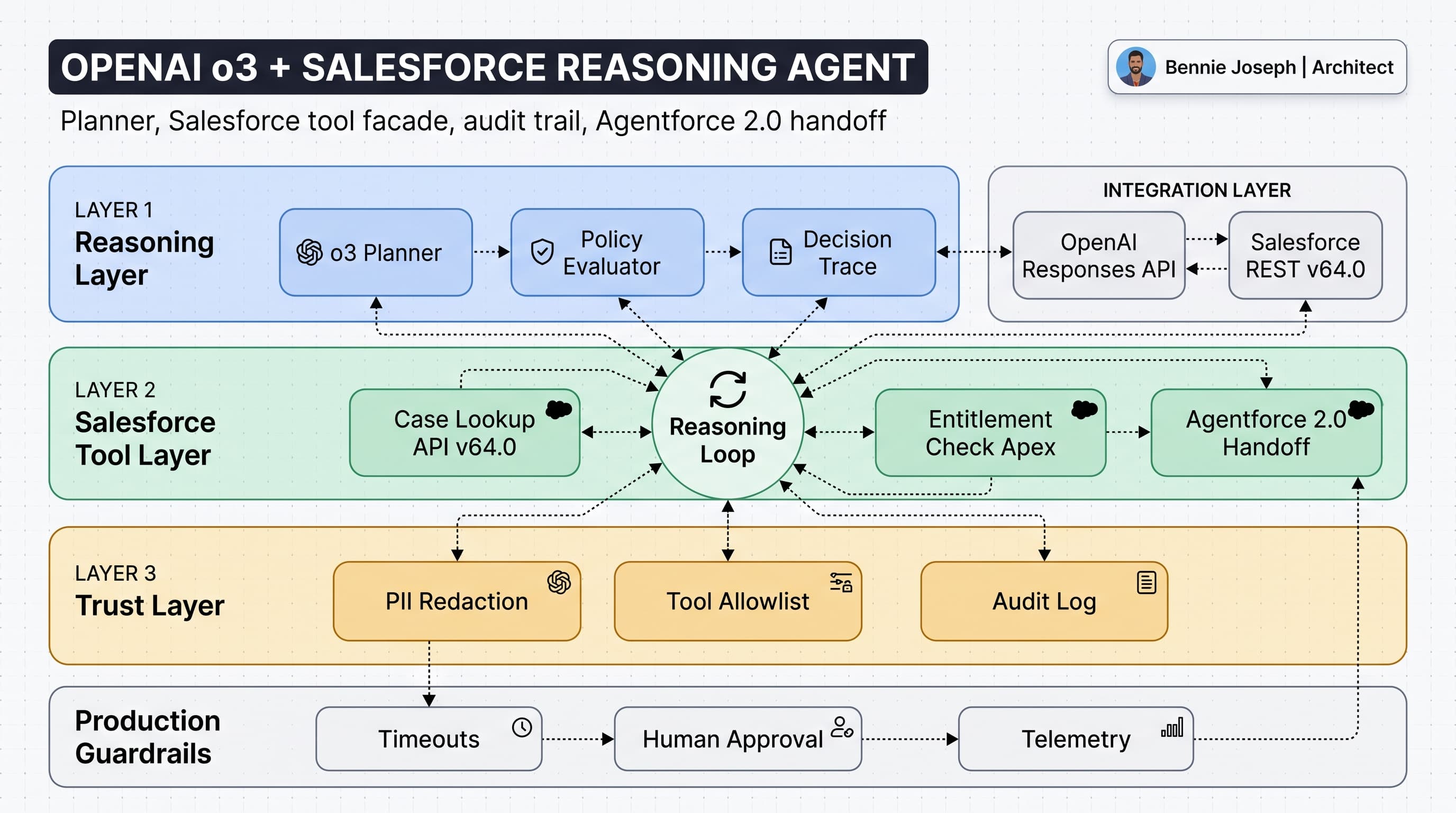
If I’m building an openai o3 reasoning agent salesforce implementation, I do not start with chat. I start with decisions.
That is the difference between a chatbot and a reasoning agent. A chatbot answers. A reasoning agent inspects facts, chooses tools, validates intermediate results, writes an auditable decision, and knows when to hand off.
For Salesforce teams, this matters because most enterprise work is not “generate a friendly answer.” It is: determine entitlement, check contract terms, compare open cases, calculate risk, update CRM data, and explain why the decision was made.
Today, I use o3 when the workflow has real branching logic. I use gpt-5.5 when I need a flagship general model for broad generation, summarization, and customer-facing text. I use Agentforce 2.0 when the workflow should live natively inside Salesforce with Atlas Reasoning Engine v2, Salesforce permissions, and admin-managed actions. The best architecture often combines them.
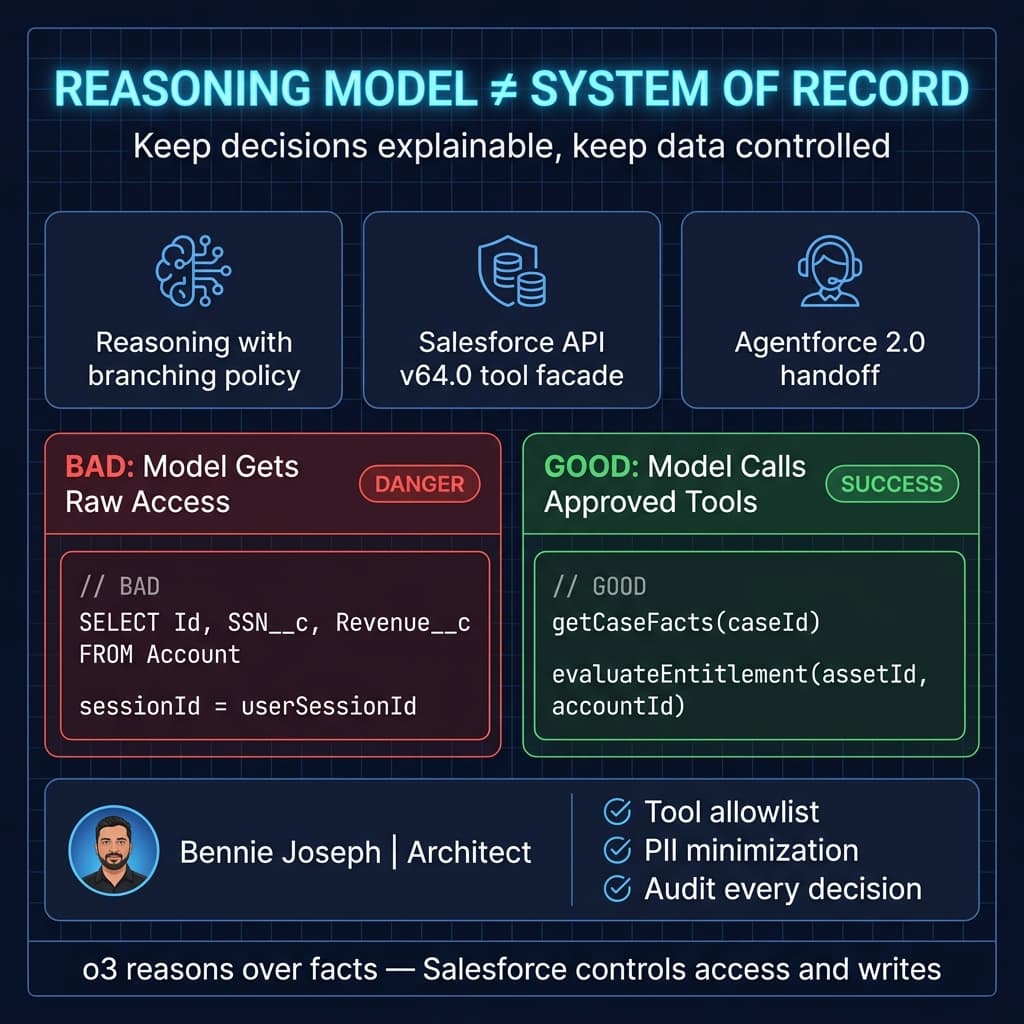
Here is the unpopular take: do not make o3 your Salesforce admin. Make it your reasoning layer. Salesforce should remain the system of record, policy enforcement point, and audit source.
The use case: reason over a high-value support escalation
The enterprise example I’ll use is from a manufacturing service environment.
A customer logs a Sev-1 case because a production machine is down. The support rep needs to know:
- Is the asset under warranty?
- Does the customer have premium support?
- Are there similar incidents in the last 90 days?
- Should this trigger field service dispatch?
- Does the escalation require manager approval?
- What should be written back to the Case?
This is exactly where a reasoning agent earns its keep. Flow can orchestrate basic rules. Apex can enforce deterministic checks. Agentforce 2.0 can guide the service rep. But when the decision requires multi-step investigation, conditional tool use, and a written rationale, o3 is a strong fit.
My production pattern looks like this:
- Salesforce sends a minimal task payload to a middleware agent service.
o3plans the investigation.- The agent calls only approved Salesforce tools.
- Salesforce returns structured facts, not random record dumps.
o3produces a decision JSON with confidence, reasoning summary, and required actions.- Salesforce stores the audit and optionally hands off to Agentforce 2.0 for rep interaction.
No direct SOQL from the model. No “here is a session ID, good luck.” No uncontrolled write access.
Why o3 instead of a normal chat model?
I like o3 for workflows where the model must slow down and reason through dependencies. For example:
- “If the account has premium support and the asset downtime is above 4 hours, dispatch field service unless there is already an active work order.”
- “If the customer has three similar cases in 90 days, escalate to engineering even if entitlement is valid.”
- “If warranty expired but there is an active service contract, apply contract coverage instead of warranty coverage.”
A fast model can pattern-match this. A reasoning model is better at maintaining the decision tree, asking for missing facts, and avoiding premature conclusions.
That does not mean o3 should do everything. I still use deterministic code for calculations, data access, authorization, and writes. The agent reasons. Salesforce governs.
Reference architecture
I usually build this as a small agent service between Salesforce and OpenAI.
Salesforce does not call OpenAI directly from random Apex triggers. That becomes painful fast: retries, observability, prompt versioning, token limits, redaction, and tool loops are better handled outside the transaction boundary.
The architecture:
- Salesforce Case action: User clicks “Analyze Escalation” or Agentforce 2.0 invokes an action.
- Apex facade: Sends only
caseId,userId, and task type to middleware. - Agent service: Runs the
o3reasoning loop. - Salesforce tool endpoints: Apex REST or external service endpoints that return structured facts.
- Audit object: Stores prompt version, tool calls, decision, confidence, and final recommendation.
- Agentforce 2.0: Presents the recommendation and next-best action in the service console.
This gives me separation of concerns. Apex owns Salesforce rules. o3 owns reasoning. Agentforce owns the user experience.
TypeScript agent service using o3 and Salesforce API v64.0
Here is a stripped-down version of the agent service. This is not demo pseudo-code. This is the shape I use in real projects: a tool allowlist, typed tool handlers, Salesforce API v64.0 calls, and a final structured decision.
import OpenAI from "openai";

type CaseAnalysisRequest = {
  caseId: string;
  salesforceInstanceUrl: string;
  salesforceAccessToken: string;
};

type ToolResult = {
  tool: string;
  result: unknown;
};

const openai = new OpenAI({
  apiKey: process.env.OPENAI_API_KEY
});

async function salesforceGet<T>(
  instanceUrl: string,
  accessToken: string,
  path: string
): Promise<T> {
  const response = await fetch(`${instanceUrl}/services/data/v64.0${path}`, {
    headers: {
      Authorization: `Bearer ${accessToken}`,
      "Content-Type": "application/json"
    }
  });

  if (!response.ok) {
    throw new Error(`Salesforce API failed: ${response.status} ${await response.text()}`);
  }

  return response.json() as Promise<T>;
}

async function getCaseFacts(req: CaseAnalysisRequest) {
  const soql = encodeURIComponent(`
    SELECT Id, CaseNumber, Priority, Status, Subject, AssetId, AccountId,
           CreatedDate, SuppliedEmail
    FROM Case
    WHERE Id = '${req.caseId}'
    LIMIT 1
  `);

  return salesforceGet(req.salesforceInstanceUrl, req.salesforceAccessToken, `/query?q=${soql}`);
}

async function getRelatedIncidentSummary(req: CaseAnalysisRequest, accountId: string) {
  const soql = encodeURIComponent(`
    SELECT Id, CaseNumber, Priority, Status, CreatedDate, Subject
    FROM Case
    WHERE AccountId = '${accountId}'
    AND CreatedDate = LAST_N_DAYS:90
    ORDER BY CreatedDate DESC
    LIMIT 20
  `);

  return salesforceGet(req.salesforceInstanceUrl, req.salesforceAccessToken, `/query?q=${soql}`);
}

async function evaluateEntitlement(req: CaseAnalysisRequest, assetId: string, accountId: string) {
  return salesforceGet(
    req.salesforceInstanceUrl,
    req.salesforceAccessToken,
    `/actions/custom/apex/EntitlementEvaluation?assetId=${assetId}&accountId=${accountId}`
  );
}

const toolHandlers = {
  get_case_facts: async (req: CaseAnalysisRequest) => getCaseFacts(req),

  get_related_incident_summary: async (
    req: CaseAnalysisRequest,
    args: { accountId: string }
  ) => getRelatedIncidentSummary(req, args.accountId),

  evaluate_entitlement: async (
    req: CaseAnalysisRequest,
    args: { assetId: string; accountId: string }
  ) => evaluateEntitlement(req, args.assetId, args.accountId)
};

export async function analyzeEscalation(req: CaseAnalysisRequest) {
  const input = `
You are a Salesforce service escalation reasoning agent.

Task:
Analyze Case ${req.caseId} and decide whether to recommend escalation,
field service dispatch, manager approval, or standard support.

Rules:
- Use tools for Salesforce facts. Do not invent record data.
- Do not request or expose unnecessary PII.
- If facts are missing, ask for the specific tool result needed.
- Return final output as JSON with:
  decision, confidence, recommendedActions, reasoningSummary, missingData, auditLabels.
`;

  let response = await openai.responses.create({
    model: "o3",
    reasoning: { effort: "high" },
    input,
    tools: [
      {
        type: "function",
        name: "get_case_facts",
        description: "Returns minimal Case facts for escalation analysis.",
        parameters: {
          type: "object",
          properties: {},
          additionalProperties: false
        }
      },
      {
        type: "function",
        name: "get_related_incident_summary",
        description: "Returns recent related cases for the same Account.",
        parameters: {
          type: "object",
          properties: {
            accountId: { type: "string" }
          },
          required: ["accountId"],
          additionalProperties: false
        }
      },
      {
        type: "function",
        name: "evaluate_entitlement",
        description: "Evaluates warranty, contract, and premium support coverage.",
        parameters: {
          type: "object",
          properties: {
            assetId: { type: "string" },
            accountId: { type: "string" }
          },
          required: ["assetId", "accountId"],
          additionalProperties: false
        }
      }
    ]
  });

  const toolResults: ToolResult[] = [];

  while (true) {
    const functionCalls = response.output.filter((item: any) => item.type === "function_call");

    if (functionCalls.length === 0) {
      return {
        final: response.output_text,
        toolResults
      };
    }

    const toolOutputs = [];

    for (const call of functionCalls as any[]) {
      const toolName = call.name as keyof typeof toolHandlers;
      const args = call.arguments ? JSON.parse(call.arguments) : {};

      if (!toolHandlers[toolName]) {
        throw new Error(`Tool not allowed: ${call.name}`);
      }

      const result = await toolHandlers[toolName](req, args);
      toolResults.push({ tool: call.name, result });

      toolOutputs.push({
        type: "function_call_output",
        call_id: call.call_id,
        output: JSON.stringify(result)
      });
    }

    response = await openai.responses.create({
      model: "o3",
      reasoning: { effort: "high" },
      previous_response_id: response.id,
      input: toolOutputs
    });
  }
}
A few things are deliberate here.
First, the model gets tool names, not Salesforce credentials. Second, each tool has a narrow job. Third, the agent cannot call arbitrary SOQL. Fourth, final output is JSON because downstream Salesforce automation should not parse vibes.
If you want to use gpt-5.5 for a customer-facing explanation after the decision, that is fine. I often do that. But I keep o3 on the decisioning path when the workflow is heavily conditional.
Apex facade for entitlement evaluation
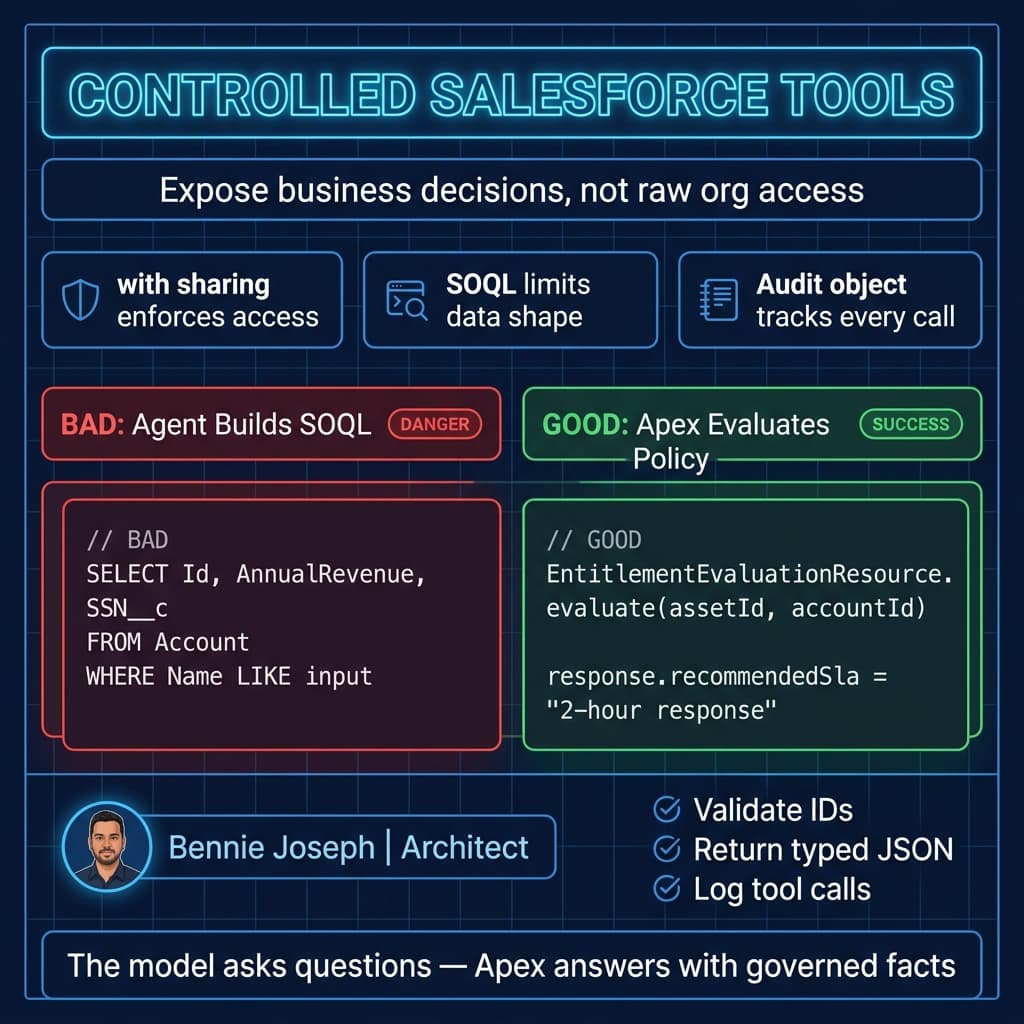
I do not let the model decide entitlement from raw objects. Entitlement logic belongs in Salesforce because it changes with contracts, service plans, regions, and approval rules.
Here is a simplified Apex REST endpoint that exposes a controlled entitlement tool.
@RestResource(urlMapping='/EntitlementEvaluation')
global with sharing class EntitlementEvaluationResource {
    global class EntitlementResponse {
        public Boolean hasCoverage;
        public Boolean premiumSupport;
        public Boolean warrantyActive;
        public String coverageSource;
        public String recommendedSla;
        public List<String> reasons;
    }

    @HttpGet
    global static EntitlementResponse evaluate() {
        RestRequest request = RestContext.request;

        Id assetId = (Id) request.params.get('assetId');
        Id accountId = (Id) request.params.get('accountId');

        if (assetId == null || accountId == null) {
            throw new AuraHandledException('assetId and accountId are required.');
        }

        Asset assetRecord = [
            SELECT Id, AccountId, Warranty_End_Date__c, Status
            FROM Asset
            WHERE Id = :assetId
            AND AccountId = :accountId
            LIMIT 1
        ];

        List<ServiceContract> contracts = [
            SELECT Id, Status, StartDate, EndDate, Support_Level__c
            FROM ServiceContract
            WHERE AccountId = :accountId
            AND Status = 'Active'
            AND StartDate <= TODAY
            AND EndDate >= TODAY
            ORDER BY EndDate DESC
            LIMIT 5
        ];

        EntitlementResponse response = new EntitlementResponse();
        response.reasons = new List<String>();

        response.warrantyActive =
            assetRecord.Warranty_End_Date__c != null &&
            assetRecord.Warranty_End_Date__c >= Date.today();

        response.premiumSupport = false;

        for (ServiceContract contractRecord : contracts) {
            if (contractRecord.Support_Level__c == 'Premium') {
                response.premiumSupport = true;
                response.reasons.add('Active Premium service contract found: ' + contractRecord.Id);
                break;
            }
        }

        response.hasCoverage = response.warrantyActive || response.premiumSupport;
        response.coverageSource = response.premiumSupport
            ? 'ServiceContract'
            : response.warrantyActive ? 'Warranty' : 'None';

        response.recommendedSla = response.premiumSupport
            ? '2-hour response'
            : response.warrantyActive ? 'Next business day' : 'Billable support review';

        if (response.warrantyActive) {
            response.reasons.add('Asset warranty is active.');
        }

        if (!response.hasCoverage) {
            response.reasons.add('No active warranty or premium support contract found.');
        }

        return response;
    }
}
This endpoint is intentionally boring. That is a compliment. Reasoning agents get safer when your tools are predictable.
In a real implementation, I would add custom permission checks, platform event logging, named credentials for outbound calls, and a custom object like AI_Decision_Audit__c. I would also avoid throwing raw exception details back to the model.
Writing the decision back to Salesforce
The final response from o3 should be treated as a recommendation until a Salesforce rule or human approves it.
A good final JSON looks like this:
{
  "decision": "ESCALATE_AND_DISPATCH",
  "confidence": 0.86,
  "recommendedActions": [
    "Create Field Service work order",
    "Notify premium support manager",
    "Attach related incident summary to Case"
  ],
  "reasoningSummary": "The asset is covered by an active Premium service contract, the case is Sev-1, and the account has four similar incidents in the last 90 days.",
  "missingData": [],
  "auditLabels": ["premium_support", "repeat_incident", "sev1"]
}
I normally persist that into Salesforce as:
AI_Decision_Audit__cCase.AI_Recommendation__cCase.AI_Confidence__cCase.AI_Reasoning_Summary__cCase.Requires_Manager_Approval__c
Do not dump the entire hidden reasoning trace into the Case. Store operational summaries and tool call metadata. The goal is auditability, not leaking internal reasoning or sensitive data.
Where Agentforce 2.0 fits
Agentforce 2.0 is the right user-facing layer for this pattern.
With Atlas Reasoning Engine v2, custom reasoning steps, and multi-agent orchestration, Agentforce can coordinate a service rep experience that feels native. But I still prefer external o3 reasoning for certain specialized decision workloads when I need:
- custom tool loops outside Salesforce transaction limits,
- model-specific reasoning behavior,
- cross-system calls beyond Salesforce,
- independent prompt deployment,
- detailed telemetry across multiple enterprise systems.
The handoff is straightforward: the external agent writes the decision and audit records, then Agentforce 2.0 uses those records in the console conversation.
For example, the rep asks:
“Why is this case being escalated?”
Agentforce can answer from Salesforce-owned data:
“This case is recommended for escalation because the asset has Premium coverage, the case is Sev-1, and there are four related incidents in the last 90 days.”
That answer should not require rerunning the reasoning agent. The decision has already been made, stored, and governed.
LWC console pattern with native state
For the service console, I prefer a small LWC panel that shows the current recommendation, tool status, and action buttons. With Summer ’26 native state support in LWC, keeping local UI state clean is easier than building unnecessary pub-sub plumbing.
import { LightningElement, api } from "lwc";
import analyzeCase from "@salesforce/apex/CaseReasoningController.analyzeCase";

type AgentState = {
  loading: boolean;
  decision?: string;
  confidence?: number;
  reasoningSummary?: string;
  error?: string;
};

export default class CaseReasoningPanel extends LightningElement {
  @api recordId!: string;

  state: AgentState = {
    loading: false
  };

  async runAnalysis() {
    this.state = { loading: true };

    try {
      const result = await analyzeCase({ caseId: this.recordId });

      this.state = {
        loading: false,
        decision: result.decision,
        confidence: result.confidence,
        reasoningSummary: result.reasoningSummary
      };
    } catch (error: any) {
      this.state = {
        loading: false,
        error: error.body?.message ?? "Reasoning analysis failed."
      };
    }
  }

  get confidencePercent() {
    return this.state.confidence
      ? `${Math.round(this.state.confidence * 100)}%`
      : "Not available";
  }
}
Keep the UI boring. Show the decision, the confidence, the facts used, and the next action. Do not stream a wall of model text into the service console and call it productivity.
Guardrails I would not skip
There are five guardrails I treat as mandatory.
1. Tool allowlists
The agent should only call named tools. No arbitrary endpoints. No freeform SOQL. No dynamic object access because “the model asked nicely.”
2. Data minimization
Send the minimum facts needed for the decision. In a support escalation flow, the model probably does not need billing address, tax ID, full email threads, or personal identifiers.
3. Deterministic writes
I rarely let the model write directly. The model recommends. Apex validates and writes. For high-risk actions, route through approval or Agentforce confirmation.
4. Prompt and policy versioning
Store promptVersion, policyVersion, and model with every decision. Six months later, when someone asks why a case was escalated, “the AI said so” is not an answer.
5. Observability
Log latency, tool count, failed tool calls, decision distribution, confidence distribution, and override rate. The override rate is gold. If reps override 40% of recommendations, your agent is not production-ready.
Common mistakes
The biggest mistake I see is treating the reasoning model like a Salesforce integration user.
That creates a security and governance mess. The model does not need broad object permissions. Your middleware or Apex facade should perform authorization, shape the response, and redact fields.
The second mistake is overusing reasoning models. If the workflow is deterministic, use Flow or Apex. If the task is summarization, use gpt-5.5 or a cheaper model where appropriate. If the work is native CRM assistant behavior, consider Agentforce 2.0 first.
The third mistake is not designing for disagreement. A good enterprise agent needs human override, feedback capture, and clean rollback. Especially in service, sales, finance, healthcare, and field operations.
My production recommendation
For a serious openai o3 reasoning agent salesforce build, I would ship this in phases.
Phase one: read-only reasoning. The agent analyzes cases and writes recommendations to an audit object.
Phase two: assisted actions. The agent recommends work order creation, escalation, or manager approval, but the rep confirms through Agentforce 2.0 or an LWC action.
Phase three: controlled automation. Low-risk decisions execute automatically when confidence is high and policy conditions are deterministic.
That progression keeps you out of trouble. It also gives the business time to build trust.
I am bullish on reasoning agents, but only when they are surrounded by boring enterprise controls. The magic is not the prompt. The magic is the architecture that lets the model reason without letting it run your org.
TL;DR
- Use
o3for multi-step Salesforce reasoning, but keep Salesforce as the governed system of record. - Expose narrow Apex or REST tools; never give the model raw SOQL or broad write access.
- Pair external reasoning with Agentforce 2.0 for native handoff, auditability, and rep experience.