From Salesforce Dev to AI Architect: The 2026 Roadmap
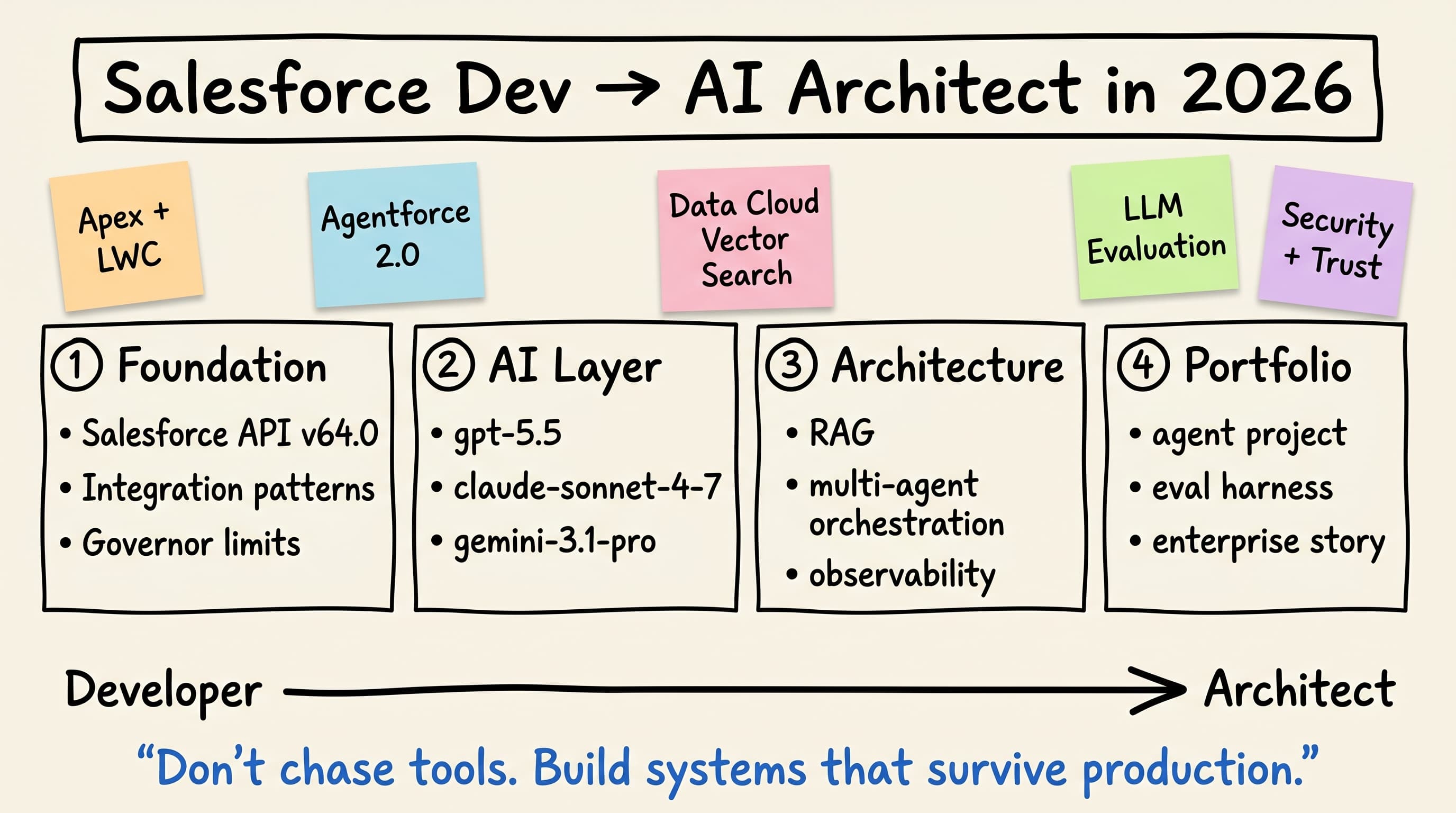
If you are a Salesforce developer in 2026, you are sitting on one of the best career arbitrage opportunities in enterprise tech.
Not because AI is magic. It is not.
Because most companies do not need another person who can paste prompts into a chatbot. They need people who understand business process, permissions, data models, integrations, compliance, release management, and how to turn AI into something users can safely run inside production systems.
That is where Salesforce developers have an unfair advantage.
I have spent years building Salesforce platforms for enterprise teams, and the pattern is obvious: the best AI architects are not pure model people. They are system people. They understand where the data lives, who can access it, what happens when automation fails, and which executive gets angry when a workflow sends the wrong email to 40,000 customers.
So this is my practical roadmap for the salesforce developer ai architect career 2026 path.
No hype. No “learn prompt engineering and retire” nonsense. This is the skill stack I would build if I were starting from Salesforce development today and wanted to become an AI architect who can actually ship.
The Career Shift: From Feature Builder To Decision-System Designer
A Salesforce developer usually starts by building features:
- Apex triggers
- Lightning Web Components
- Flows
- REST integrations
- Batch jobs
- Permission models
- Reports and dashboards
An AI architect designs decision systems.
That means you are responsible for how data, automation, models, users, and governance work together. You are not just asking, “Can the agent answer this question?” You are asking:
- Should the agent answer this question?
- Which data is it allowed to use?
- How do we verify the answer?
- What happens when confidence is low?
- When should a human approve the action?
- How do we monitor cost, latency, quality, and risk?
- How does this fit into Salesforce security and release management?
Here’s the unpopular take: most “AI projects” fail because teams skip the boring architecture work Salesforce professionals already know how to do.
They build demos. They do not build systems.
Your opportunity is to become the person who can bridge both worlds.
Phase 1: Keep Your Salesforce Core Sharp
Do not abandon Salesforce fundamentals to chase AI.
That is the fastest way to become average at two things.
In 2026, I expect a serious Salesforce-to-AI architect to be strong in:
- Apex bulkification and transaction design
- LWC with native state management from Summer ’26
- Salesforce API v64.0
- Platform Events and event-driven architecture
- Named Credentials and External Credentials
- Flow orchestration boundaries
- Data Cloud real-time unification
- Data Cloud native vector search
- Security: sharing, CRUD/FLS, restriction rules, permission sets
- Integration patterns: sync, async, polling, event-driven, middleware
AI does not remove the need for these skills. It makes them more important.
If an Agentforce 2.0 agent updates an Opportunity, invokes a Flow, calls an external API, and writes a summary back to a custom object, you still need to understand transaction boundaries, permissions, retries, and auditability.
The model is just one component.
The enterprise system is the product.
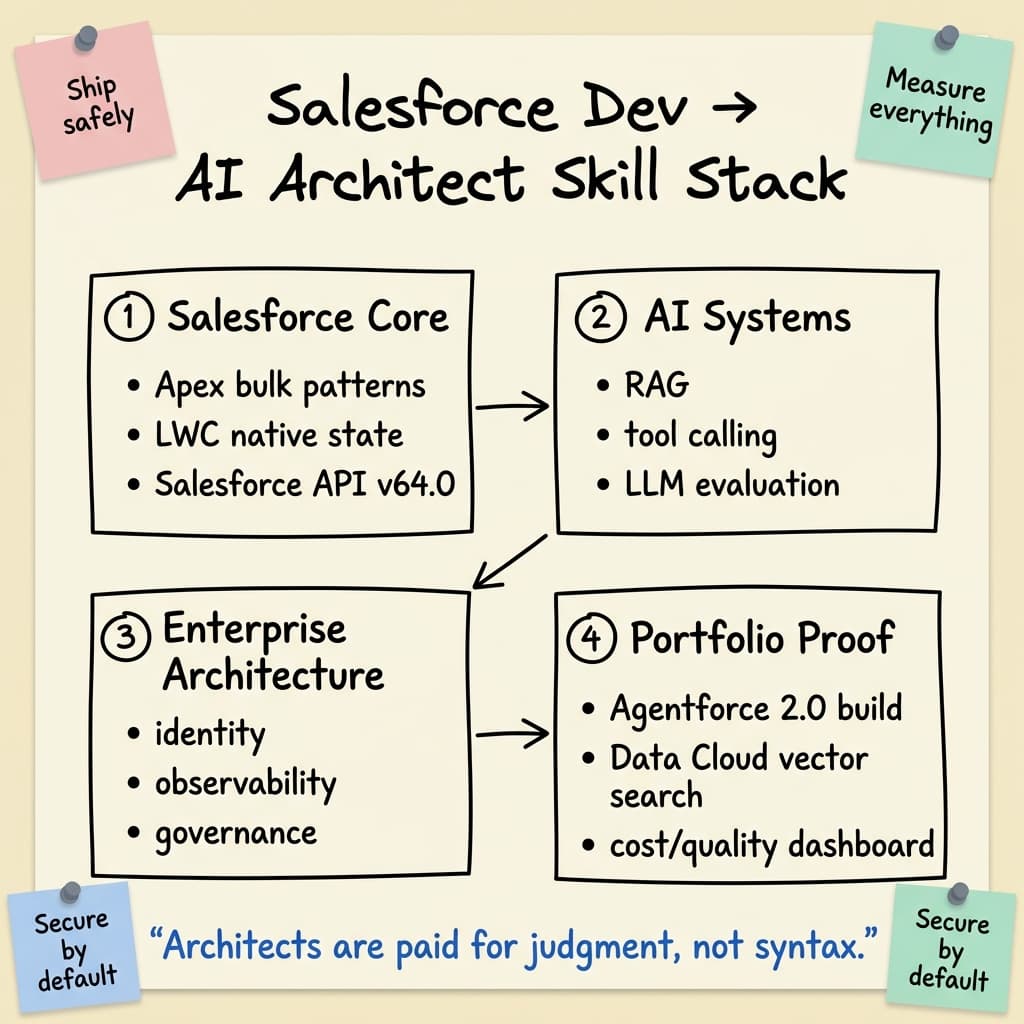
Phase 2: Learn The AI Architecture Primitives
You do not need a PhD to be useful in enterprise AI.
You do need to understand the primitives well enough to make architectural tradeoffs.
Models
As of 2026, I would be familiar with:
- OpenAI gpt-5.5 for flagship general-purpose reasoning and generation
- OpenAI gpt-5.5-mini for fast, cheap workloads
- OpenAI o3 for deeper reasoning patterns
- Anthropic claude-sonnet-4-7 as a strong default for enterprise coding and analysis
- Anthropic claude-opus-4-7 for high-stakes reasoning
- Anthropic claude-haiku-4-7 for lower-cost high-volume tasks
- Google gemini-3.1-pro and gemini-3.1-ultra for capable multimodal and reasoning workloads
- Llama 4 Scout when local or open-source deployment matters
Do not become religious about one model.
Model loyalty is a junior mistake. Architecture is about matching workload, cost, latency, privacy, quality, and vendor constraints.
Retrieval-Augmented Generation
RAG is not “upload documents and ask questions.”
A real RAG system includes:
- chunking strategy
- metadata strategy
- embeddings
- retrieval filters
- reranking
- permissions trimming
- prompt assembly
- citation handling
- evaluation
- feedback loops
In Salesforce, Data Cloud native vector search changes the conversation because enterprise customer data, identity resolution, segmentation, and retrieval can sit much closer together.
That matters.
If your support agent retrieves a policy document but ignores account tier, region, product entitlement, and active contract terms, your answer is probably wrong.
Tools And Actions
Agents become useful when they can act.
In Salesforce, that means actions such as:
- create a Case
- summarize an Account
- update a renewal risk score
- draft an email
- call an ERP API
- create a follow-up Task
- escalate to a human queue
Agentforce 2.0 with the Atlas Reasoning Engine v2 is important because it moves the conversation beyond simple chatbot flows. Multi-agent orchestration and custom reasoning steps make it possible to divide work between specialized agents: triage, policy lookup, order validation, renewal analysis, and human approval routing.
But do not confuse “multi-agent” with “better.”
More agents can also mean more latency, cost, and failure modes.
Start simple. Add orchestration when the business process actually needs it.
Phase 3: Build A Real Evaluation Habit
If you want to be taken seriously as an AI architect, stop saying “the output looks good.”
That sentence should make you uncomfortable.
AI systems need evaluations. Not academic perfection. Practical evaluation.
Here is a small TypeScript harness I would expect a Salesforce developer moving into AI architecture to understand. It compares model output for a support triage use case before you wire anything into Agentforce or production automation.
// case-triage-eval.ts
// Run with: npx tsx case-triage-eval.ts

type ModelProvider = "openai" | "anthropic";

type EvalCase = {
  id: string;
  caseSubject: string;
  caseDescription: string;
  expectedCategory: "Billing" | "Technical" | "Contract" | "Escalation";
  expectedPriority: "Low" | "Medium" | "High";
};

const evalCases: EvalCase[] = [
  {
    id: "CASE-001",
    caseSubject: "Invoice increased after renewal",
    caseDescription:
      "Customer says their annual invoice increased by 22% after auto-renewal. They want contract terms reviewed before payment.",
    expectedCategory: "Contract",
    expectedPriority: "Medium"
  },
  {
    id: "CASE-002",
    caseSubject: "Production login outage",
    caseDescription:
      "Enterprise customer reports all SSO users are blocked from logging in after this morning's identity provider certificate rotation.",
    expectedCategory: "Technical",
    expectedPriority: "High"
  }
];

const systemPrompt = `
You are a Salesforce support triage assistant.
Return strict JSON only:
{
  "category": "Billing | Technical | Contract | Escalation",
  "priority": "Low | Medium | High",
  "reason": "one short sentence"
}
Use the case subject and description only.
`;

async function callOpenAI(input: EvalCase) {
  const response = await fetch("https://api.openai.com/v1/responses", {
    method: "POST",
    headers: {
      Authorization: `Bearer ${process.env.OPENAI_API_KEY}`,
      "Content-Type": "application/json"
    },
    body: JSON.stringify({
      model: "gpt-5.5",
      input: [
        { role: "system", content: systemPrompt },
        {
          role: "user",
          content: `Subject: ${input.caseSubject}\nDescription: ${input.caseDescription}`
        }
      ],
      temperature: 0
    })
  });

  const json = await response.json();
  return JSON.parse(json.output_text);
}

async function callAnthropic(input: EvalCase) {
  const response = await fetch("https://api.anthropic.com/v1/messages", {
    method: "POST",
    headers: {
      "x-api-key": process.env.ANTHROPIC_API_KEY!,
      "anthropic-version": "2026-01-01",
      "Content-Type": "application/json"
    },
    body: JSON.stringify({
      model: "claude-sonnet-4-7",
      max_tokens: 300,
      temperature: 0,
      system: systemPrompt,
      messages: [
        {
          role: "user",
          content: `Subject: ${input.caseSubject}\nDescription: ${input.caseDescription}`
        }
      ]
    })
  });

  const json = await response.json();
  return JSON.parse(json.content[0].text);
}

async function runEval(provider: ModelProvider) {
  let passed = 0;

  for (const testCase of evalCases) {
    const result =
      provider === "openai"
        ? await callOpenAI(testCase)
        : await callAnthropic(testCase);

    const ok =
      result.category === testCase.expectedCategory &&
      result.priority === testCase.expectedPriority;

    if (ok) passed++;

    console.log({
      provider,
      id: testCase.id,
      expectedCategory: testCase.expectedCategory,
      actualCategory: result.category,
      expectedPriority: testCase.expectedPriority,
      actualPriority: result.priority,
      passed: ok
    });
  }

  console.log(`${provider} score: ${passed}/${evalCases.length}`);
}

await runEval("openai");
await runEval("anthropic");
This is not a complete enterprise evaluation framework. That is not the point.
The point is the habit.
Before you plug a model into Salesforce automation, you should have test cases, expected outputs, failure categories, and a repeatable way to compare quality across models and prompts.
That skill alone separates serious AI architects from demo builders.
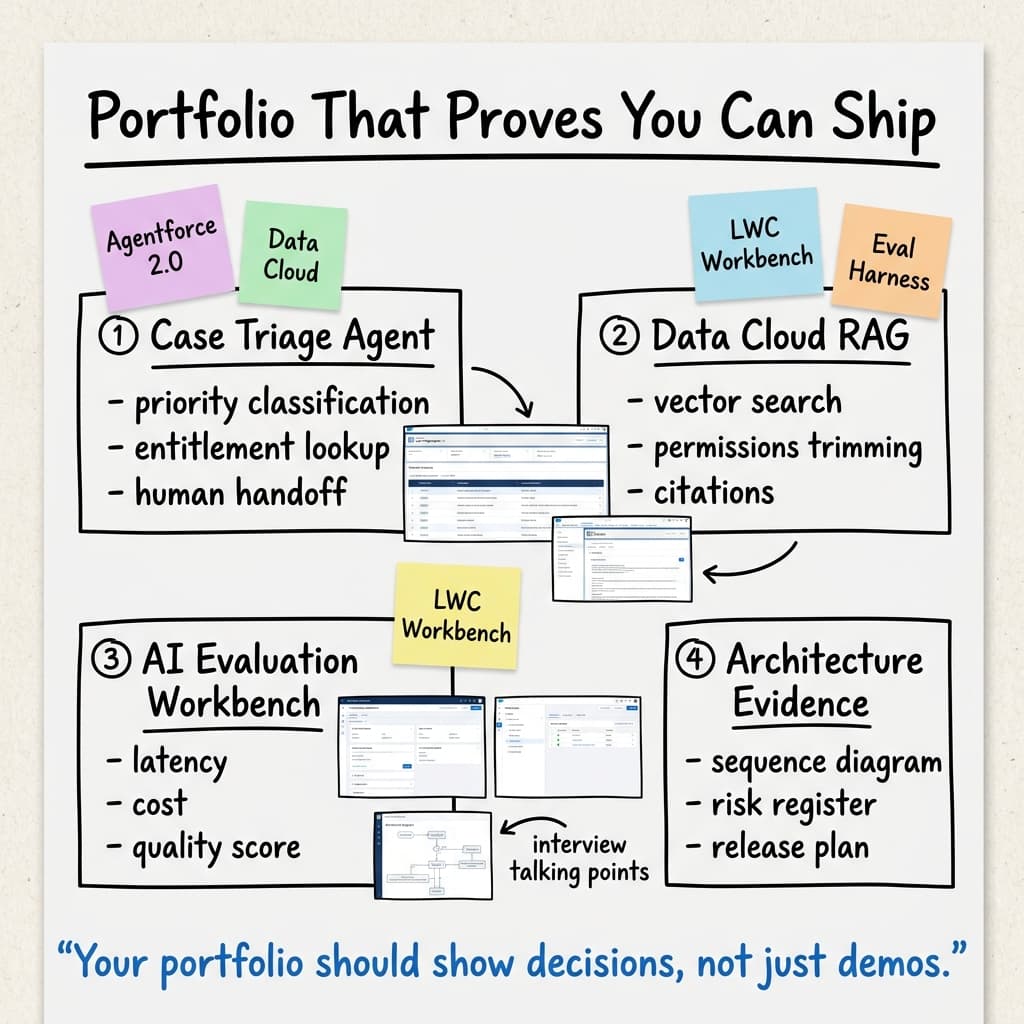
Phase 4: Build Three Portfolio Projects That Prove You Can Ship
A career roadmap without portfolio proof is just motivational content.
If I were coaching a Salesforce developer in 2026, I would tell them to build three projects.
Project 1: Agentforce 2.0 Case Triage Agent
Build an Agentforce 2.0 agent that:
- reads Case fields
- retrieves entitlement and account context
- classifies category and priority
- recommends next action
- routes to a human queue when confidence is low
- writes an audit record
Use custom reasoning steps where needed. Keep one part deterministic. For example, entitlement validation should not be “model vibes.” It should be a query, rule, or API response.
Project 2: Data Cloud RAG Assistant
Build a retrieval assistant using Data Cloud native vector search.
Make it permission-aware.
That means the user should not retrieve content they cannot access through normal enterprise rules. This is where Salesforce developers have an edge because you already think in profiles, permission sets, sharing, and data visibility.
Project 3: LWC AI Workbench
Build an internal LWC that lets an admin or support lead:
- submit sample cases
- compare model outputs
- rate responses
- see token cost
- see latency
- mark false positives
- export evaluation results
Use LWC native state management from Summer ’26 instead of over-engineering client state with unnecessary libraries.
This project shows you understand the operating model, not just the AI call.
Phase 5: Learn The Architecture Conversations Executives Care About
Developers often talk in implementation details.
Architects translate implementation into risk, cost, reliability, and business impact.
For AI architecture, you need to be ready for questions like:
- What data leaves Salesforce?
- Which model provider processes it?
- Is customer PII included?
- Can we use a smaller model for this workflow?
- How do we evaluate accuracy?
- How do we handle hallucinations?
- Can users override the agent?
- What is the rollback plan?
- What will this cost at 100,000 requests per month?
- How do we monitor production drift?
- What is logged for audit?
This is where the career jump happens.
A senior developer says, “I can integrate with gpt-5.5.”
An AI architect says, “For this use case, I recommend a two-step design: deterministic Salesforce retrieval first, model reasoning second, human approval for low-confidence actions, audit logs on every generated recommendation, and a monthly evaluation set reviewed by operations.”
That is a different level of value.
The Enterprise Example: Why Salesforce Developers Win
A real example from an enterprise project: a global B2B support organization wanted AI-assisted case triage across multiple regions.
The first version from a vendor looked impressive in a demo. It summarized cases, suggested priorities, and drafted responses.
But once we mapped it against the actual Salesforce implementation, the problems showed up fast:
- Case priority depended on Account tier and active SLA.
- Entitlements were stored across Salesforce and an external contract system.
- Some support agents could not see certain regulated product lines.
- Escalation rules varied by region.
- Knowledge articles had different approval states.
- The business needed an audit trail for AI recommendations.
- Legal did not want raw customer text sent to every provider by default.
The fix was not “write a better prompt.”
The fix was architecture.
We split the process into deterministic and AI-assisted steps:
- Salesforce queried Account, Entitlement, Product, and Case context.
- External Credentials handled secure API access to the contract system.
- A rules layer calculated SLA exposure.
- The model summarized and classified only after the required context was assembled.
- High-risk cases required human approval.
- Every recommendation was stored with model version, prompt version, input hash, and user action.
- A weekly evaluation set tracked precision by region and product line.
That is the work.
And a Salesforce developer who understands the org, the data model, the automation history, and the integration landscape is much better positioned than a generic AI consultant walking in with a slide deck.
Certifications Still Matter, But They Are Not Enough
I am a Salesforce Certified Application Architect, so I value the certification path. It forces you to learn platform boundaries and architecture vocabulary.
For this career path, I would prioritize:
- Platform Developer I and II
- JavaScript Developer I
- Data Architect
- Sharing and Visibility Architect
- Integration Architect
- Application Architect
- AI-focused Salesforce credentials as they mature around Agentforce and Einstein
But do not hide behind certifications.
In 2026, hiring managers and clients want evidence that you can build with AI safely. A badge helps. A working Agentforce 2.0 project with evaluation results helps more.
The strongest signal is a portfolio that includes:
- architecture diagrams
- code
- demo videos
- evaluation reports
- model comparison notes
- security assumptions
- failure handling
- cost estimates
That is how you move from “I learned AI” to “I can lead this implementation.”
The 12-Month Roadmap I Would Follow
Here is the path I would take.
Months 1–3: Strengthen Platform And Integration Depth
Pick one weak Salesforce area and fix it.
If your Apex is weak, bulkify until it is boring. If your integration knowledge is shallow, build with Named Credentials, External Credentials, Platform Events, and Salesforce API v64.0. If your LWC skills are stale, rebuild a complex component using native state management.
You cannot architect AI on top of a platform you only half understand.
Months 4–6: Learn AI Engineering Basics
Build small but real projects:
- model calls from TypeScript or Python
- prompt versioning
- structured JSON output
- tool calling
- embeddings
- retrieval
- eval harnesses
- latency and cost tracking
Use current models. Compare gpt-5.5, claude-sonnet-4-7, and gemini-3.1-pro on the same task. Do not ask which one is “best.” Ask which one is best for a specific workload under specific constraints.
Months 7–9: Build Salesforce-Native AI Systems
Now combine the worlds.
Build with Agentforce 2.0. Use Data Cloud vector search. Create an LWC workbench. Store audit logs in custom objects. Add admin controls. Add human approval. Add test data and evaluation sets.
This is where your portfolio becomes credible.
Months 10–12: Practice Architecture Leadership
Write design docs.
Present tradeoffs.
Create diagrams.
Estimate cost.
Define monitoring.
Explain security.
Document failure modes.
If you want architect-level work, practice architect-level communication. The job is not just knowing the answer. The job is making the decision clear enough that a business can bet money on it.
My Opinionated Advice
Do not brand yourself as an “AI prompt expert.”
That positioning is too thin.
Brand yourself as a Salesforce AI architect who can design trusted enterprise automation with Agentforce, Data Cloud, Apex, LWC, integrations, and model evaluation.
That is specific. That is valuable. That maps to real budgets.
Also, do not wait for permission.
Pick a business process you already understand: support triage, renewal risk, lead qualification, order exception handling, field service dispatch, compliance review. Build a working AI-assisted version. Then document what you learned.
The developers who become architects are usually not the ones waiting for perfect training material. They are the ones building before the org chart catches up.
TL;DR
- The best salesforce developer ai architect career 2026 path is Salesforce depth plus AI evaluation, Agentforce 2.0, Data Cloud, and enterprise governance.
- Do not chase model hype; learn to design secure, measurable decision systems that survive production.
- Build portfolio proof: an Agentforce triage agent, Data Cloud RAG assistant, and LWC AI evaluation workbench.