Llama 4 Scout on-Premise + Salesforce: When to Go Open Source
If you searched for llama 4 scout salesforce on premise ai, you are probably not asking a generic “which model is best?” question.
You are asking the enterprise question:
“Can I use open-source AI with Salesforce without leaking regulated data, blowing up support costs, or building a science project?”
My short answer: yes, but not everywhere.
Llama 4 Scout makes sense when Salesforce data must stay inside your network boundary, when inference volume makes hosted model pricing painful, or when your legal/security team needs hard control over retention, logging, and model runtime. It does not make sense when your use case needs top-tier reasoning, broad tool orchestration, or low-maintenance managed AI.
Here’s the unpopular take: most Salesforce teams should start with Agentforce 2.0 and hosted frontier models, then selectively route sensitive or high-volume workloads to Llama 4 Scout on-premise. Going open source everywhere is usually ego-driven architecture.
Where Llama 4 Scout Fits in a Salesforce Architecture
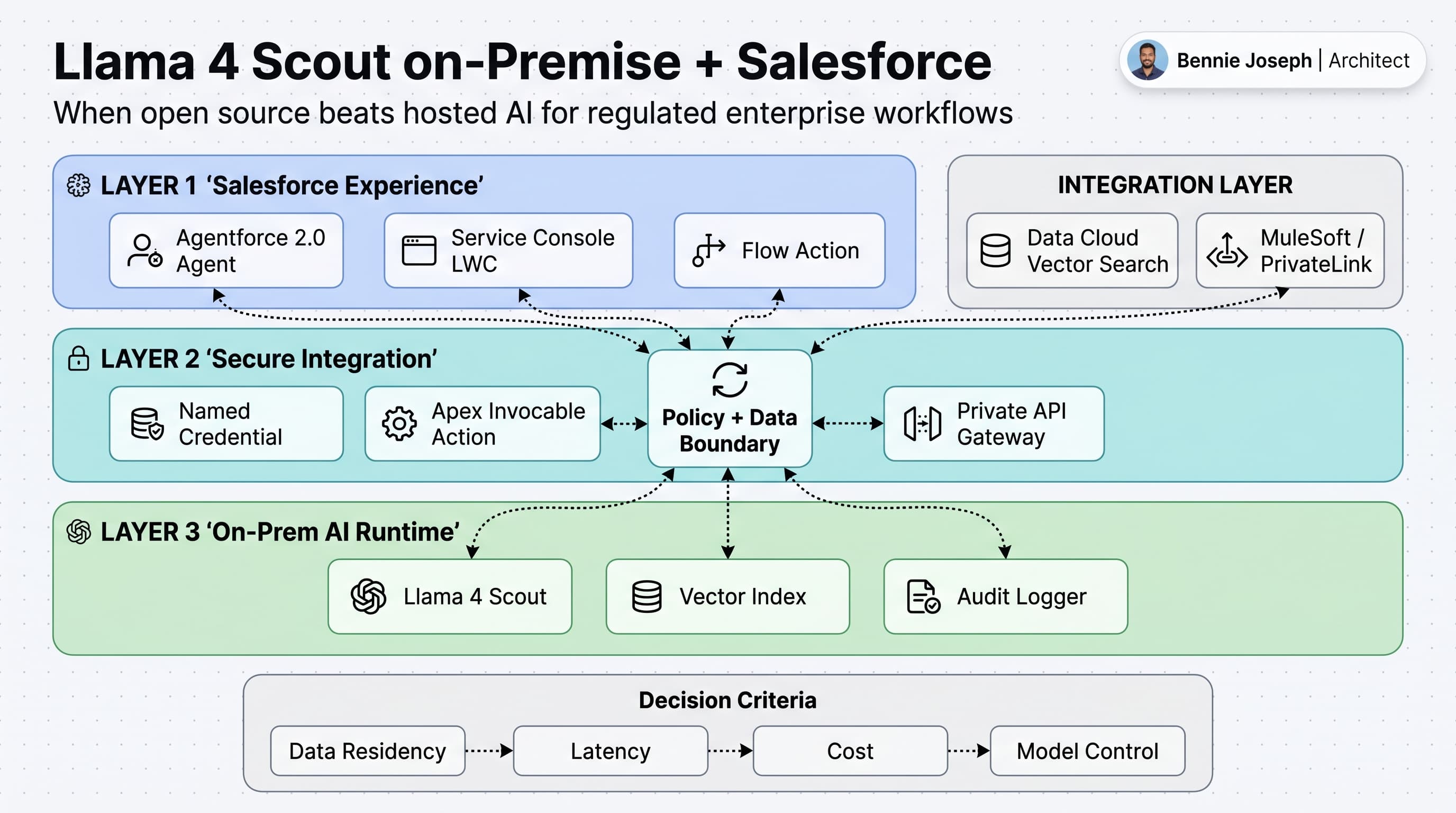
As of June 2026, my default enterprise AI stack looks like this:
- Agentforce 2.0 for CRM-native agent orchestration
- Atlas Reasoning Engine v2 for Salesforce-grounded reasoning and actions
- Data Cloud for real-time unification and native vector search
- Salesforce API v64.0 for integration surfaces
- Claude Sonnet 4.7, GPT-5.5, or Gemini 3.1 Pro/Ultra for high-reasoning hosted tasks
- Llama 4 Scout for local, open-source, controlled inference
Llama 4 Scout is not a replacement for everything. It is a boundary tool.
Use it when the real requirement is:
- “This prompt cannot leave our environment.”
- “This data cannot be retained by a third-party model provider.”
- “We need predictable inference cost at high volume.”
- “We need to inspect, tune, version, and govern the runtime.”
- “We need an internal fallback when external AI APIs are unavailable.”
In Salesforce terms, I usually put Llama 4 Scout behind a private inference gateway. Salesforce never calls the model directly. Apex, Flow, Agentforce custom actions, or MuleSoft call an internal API. That gateway handles authentication, prompt assembly, PII redaction, model invocation, telemetry, and audit logging.
That separation matters. I do not want Apex developers debugging GPU workers. I also do not want ML engineers changing Salesforce transaction behavior.
When I Would Choose Llama 4 Scout Over Hosted Models
I would choose Llama 4 Scout for Salesforce workloads in four scenarios.
1. Regulated Case Summaries
Think healthcare, insurance, public sector, and financial services.
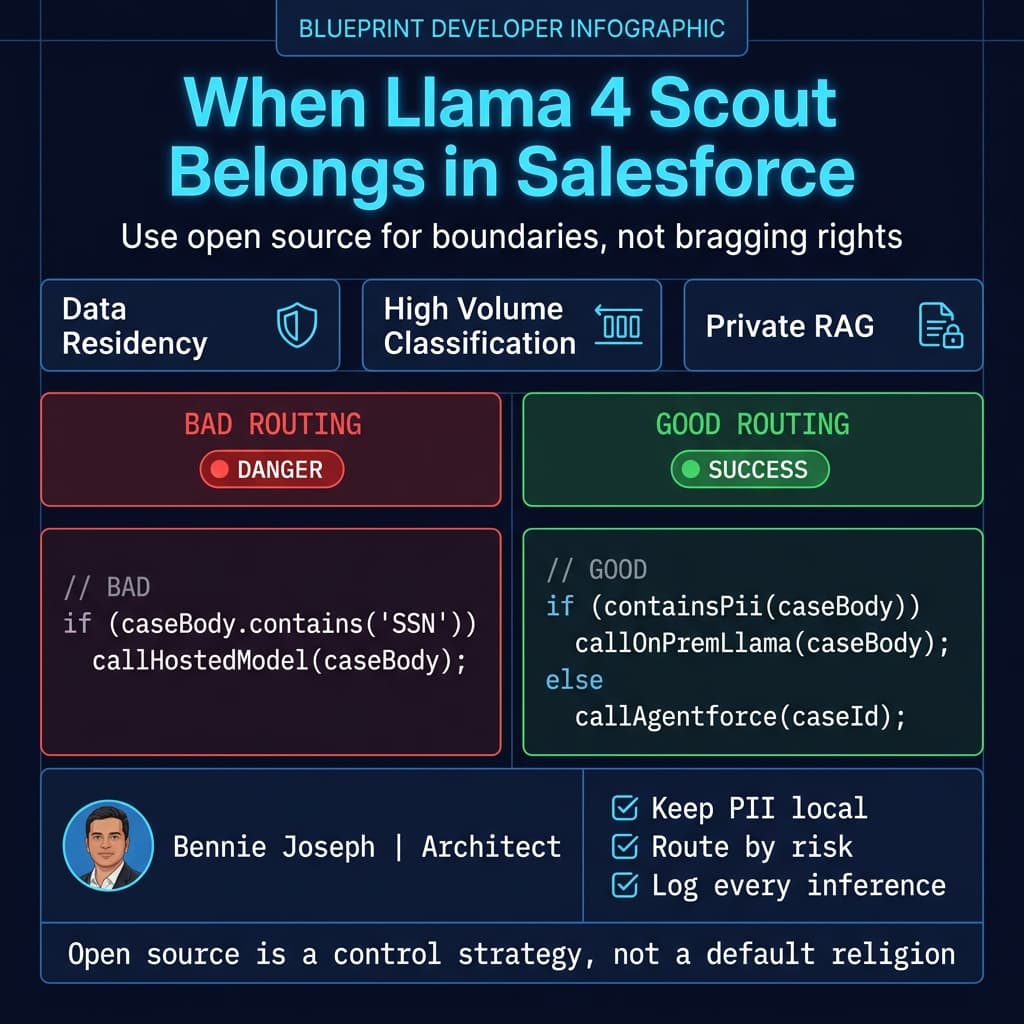
A service agent opens a Case with emails, notes, attachments, claim details, and personally identifiable information. The business wants an AI-generated summary, but legal says raw case content cannot leave the corporate network.
That is a good Llama 4 Scout workload.
The model does not need world-class multi-step reasoning. It needs to summarize, classify, redact, extract entities, and follow a strict output schema. Hosted models like Claude Opus 4.7 or GPT-5.5 may be stronger, but strength is not the only metric. Data boundary wins.
2. High-Volume Internal Classification
I worked on an enterprise service operation where millions of interactions had to be classified into routing categories. The first prototype used a hosted model and worked beautifully. Then finance saw the projected monthly bill.
Classification is exactly where open source can shine:
- low creativity
- repeatable schema
- narrow domain
- measurable accuracy
- high volume
- easy fallback rules
If Llama 4 Scout gets you 92–95% of hosted model quality at a fraction of the marginal cost, that is a serious architecture option.
3. Private Knowledge Retrieval
If your RAG pipeline is built on internal policy, contracts, SOPs, engineering docs, or customer-specific implementation notes, on-premise inference may be the right call.
Salesforce Data Cloud now has native vector search, which is useful when the source of truth lives in Salesforce and Data Cloud. But plenty of enterprise knowledge still sits outside Salesforce: SharePoint, Confluence, file shares, proprietary document stores, internal data lakes.
A private RAG service can retrieve from those sources, use Llama 4 Scout for synthesis, and only return the final structured answer to Salesforce.
4. AI Resilience and Vendor Optionality
I do not like architectures where one external model outage breaks the business process.
For mission-critical agentic flows, I like a routing layer:
- Hosted frontier model for hard reasoning
- Llama 4 Scout for private or fallback inference
- deterministic rules for safety-critical decisions
- human escalation for ambiguous outcomes
This gives you leverage. It also keeps procurement from turning your architecture into a hostage situation.
When I Would Not Use Llama 4 Scout
Open source is not free. It just moves the bill.
You pay in GPUs, monitoring, patching, evals, DevOps, security reviews, incident response, and model lifecycle management.
I would not use Llama 4 Scout as the primary model for these Salesforce use cases:
Complex Multi-Step Agent Reasoning
If the agent has to interpret ambiguous requests, call multiple tools, resolve conflicts, plan across objects, and recover from partial failures, I still prefer Agentforce 2.0 with Atlas Reasoning Engine v2 and a hosted frontier model.
Claude Sonnet 4.7, Claude Opus 4.7, GPT-5.5, o3, Gemini 3.1 Pro, and Gemini 3.1 Ultra are stronger choices for complex reasoning. Use the right model for the job.
Low-Volume Admin Productivity
If your use case is “summarize 500 records per month,” don’t build an on-premise AI platform.
Use the managed path. Your team’s time is more expensive than inference.
Customer-Facing Generative Experiences Without a Strong Safety Layer
If AI output goes directly to customers, your safety architecture matters more than your model preference.
Llama 4 Scout can be part of that system, but I would not expose it without:
- output validation
- prompt injection defenses
- allowlisted tools
- toxicity and policy filters
- human review for sensitive actions
- full audit trails
The Pattern I Use: Salesforce Calls a Private AI Gateway
Here is the architecture I trust.
Salesforce invokes an Apex action. The Apex action calls a private gateway using a Named Credential. The gateway runs inside the enterprise network. The gateway calls Llama 4 Scout locally and returns structured JSON.
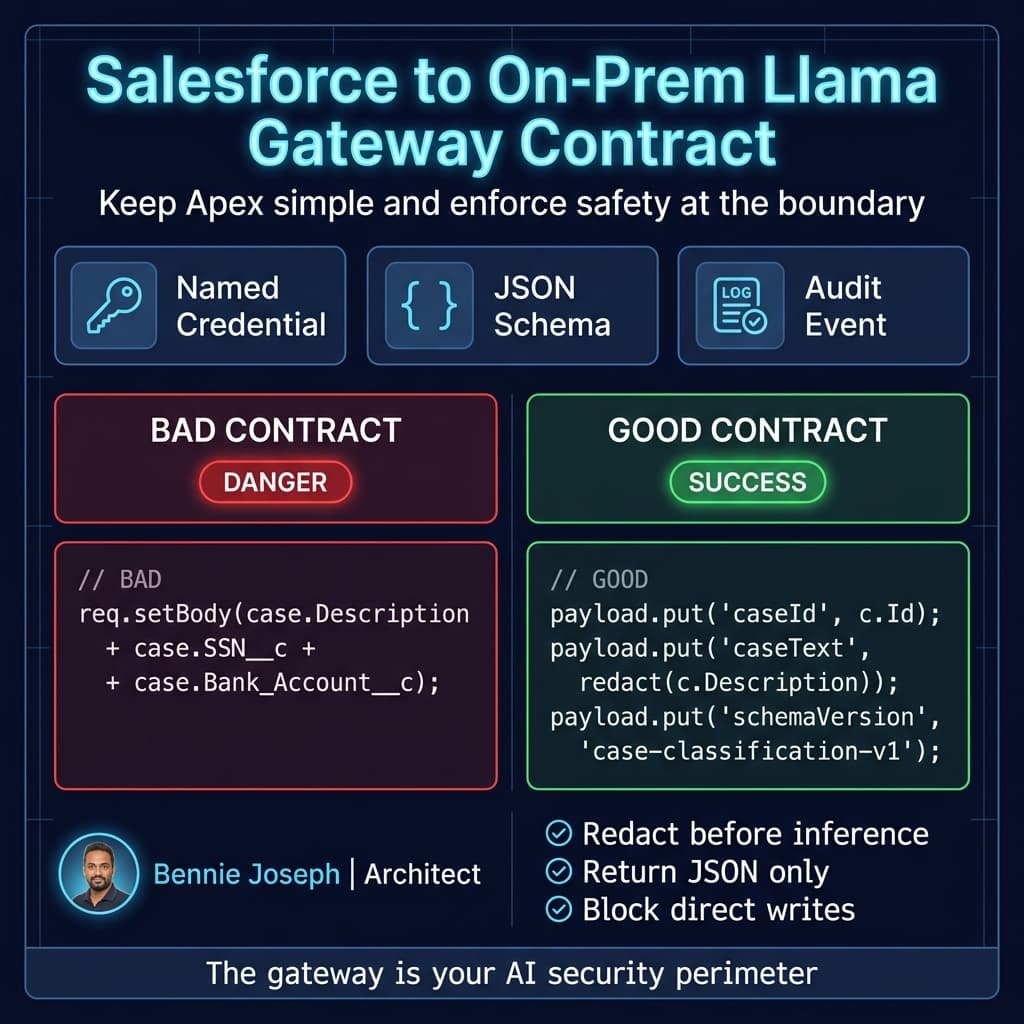
Salesforce should not care whether the backend uses Llama 4 Scout, a fine-tuned model, a vector database, or a rules engine. Salesforce should care about contract, latency, reliability, and auditability.
Here is a simplified Apex Invocable Action compiled against Salesforce API v64.0. I would expose this to Flow or Agentforce 2.0 as a custom action.
public with sharing class OnPremLlamaCaseClassifier {
    public class Request {
        @InvocableVariable(required=true)
        public Id caseId;

        @InvocableVariable(required=true)
        public String caseText;
    }

    public class Response {
        @InvocableVariable
        public Id caseId;

        @InvocableVariable
        public String category;

        @InvocableVariable
        public Decimal confidence;

        @InvocableVariable
        public String rationale;
    }

    @InvocableMethod(
        label='Classify Case with On-Prem Llama 4 Scout'
        description='Routes sensitive case text to the private Llama 4 Scout inference gateway.'
    )
    public static List<Response> classifyCases(List<Request> requests) {
        List<Response> results = new List<Response>();

        for (Request input : requests) {
            HttpRequest req = new HttpRequest();
            req.setEndpoint('callout:OnPrem_Llama_Gateway/v1/salesforce/case-classification');
            req.setMethod('POST');
            req.setHeader('Content-Type', 'application/json');
            req.setTimeout(20000);

            Map<String, Object> payload = new Map<String, Object>{
                'caseId' => String.valueOf(input.caseId),
                'caseText' => input.caseText,
                'schemaVersion' => 'case-classification-v1',
                'source' => 'salesforce-api-v64'
            };

            req.setBody(JSON.serialize(payload));

            Http http = new Http();
            HttpResponse res = http.send(req);

            if (res.getStatusCode() >= 300) {
                throw new CalloutException(
                    'On-prem Llama gateway failed: ' +
                    res.getStatusCode() + ' ' + res.getBody()
                );
            }

            Map<String, Object> body =
                (Map<String, Object>) JSON.deserializeUntyped(res.getBody());

            Response output = new Response();
            output.caseId = input.caseId;
            output.category = (String) body.get('category');
            output.confidence = Decimal.valueOf(String.valueOf(body.get('confidence')));
            output.rationale = (String) body.get('rationale');

            results.add(output);
        }

        return results;
    }
}
This is intentionally boring Apex. That is the point.
The complexity belongs behind the gateway, not scattered across triggers, Flows, LWCs, and agent actions.
A private gateway might look like this in Python. This example uses a local OpenAI-compatible inference endpoint running Llama 4 Scout inside the enterprise environment.
from fastapi import FastAPI, HTTPException
from pydantic import BaseModel, Field
from openai import OpenAI
import json
import os
import time

app = FastAPI(title="Salesforce On-Prem Llama Gateway")

client = OpenAI(
    base_url=os.environ["LOCAL_LLAMA_BASE_URL"],
    api_key=os.environ.get("LOCAL_LLAMA_API_KEY", "local-only")
)

class CaseClassificationRequest(BaseModel):
    caseId: str
    caseText: str
    schemaVersion: str = Field(default="case-classification-v1")
    source: str

class CaseClassificationResponse(BaseModel):
    category: str
    confidence: float
    rationale: str

@app.post("/v1/salesforce/case-classification", response_model=CaseClassificationResponse)
def classify_case(request: CaseClassificationRequest):
    started = time.time()

    if len(request.caseText) > 12000:
        raise HTTPException(status_code=413, detail="caseText exceeds allowed limit")

    system_prompt = """
You classify Salesforce service cases for internal routing.
Return only valid JSON with keys: category, confidence, rationale.
Allowed categories: Billing, Technical Support, Contract, Claims, Compliance, Other.
Do not include customer PII in the rationale.
"""

    user_prompt = f"""
Salesforce Case Id: {request.caseId}

Case Text:
{request.caseText}
"""

    completion = client.chat.completions.create(
        model="Llama-4-Scout",
        messages=[
            {"role": "system", "content": system_prompt.strip()},
            {"role": "user", "content": user_prompt.strip()}
        ],
        temperature=0.1,
        response_format={"type": "json_object"}
    )

    raw = completion.choices[0].message.content

    try:
        parsed = json.loads(raw)
        return CaseClassificationResponse(
            category=parsed["category"],
            confidence=float(parsed["confidence"]),
            rationale=parsed["rationale"]
        )
    except Exception as exc:
        raise HTTPException(
            status_code=502,
            detail=f"Model returned invalid classification JSON: {str(exc)}"
        )
    finally:
        elapsed_ms = int((time.time() - started) * 1000)
        print({
            "event": "llama_case_classification",
            "caseId": request.caseId,
            "elapsedMs": elapsed_ms,
            "schemaVersion": request.schemaVersion,
            "source": request.source
        })
In production, I would add mTLS, request signing, rate limits, PII detection, prompt injection checks, structured logs, model version headers, and a retry strategy. I would also store the inference audit event somewhere security can query without asking the Salesforce team to export debug logs.
Real Enterprise Example: Insurance Claims Triage
A good example is insurance claims triage.
The Salesforce org had Service Cloud, Experience Cloud, Data Cloud, and several backend claim systems. Adjusters worked from Salesforce Cases, but the sensitive claim documents lived in an internal document platform. The business wanted three AI features:
- summarize claim history
- classify claim urgency
- suggest next best internal action
The first prototype used a hosted model and impressed everyone. It also triggered a hard security stop because claim notes, medical details, legal language, and bank information could appear in prompts.
We redesigned the flow.
Salesforce sent only the Case Id and routing context to a private gateway. The gateway retrieved claim documents internally, redacted unnecessary fields, ran Llama 4 Scout for classification and summarization, and returned structured results to Salesforce. Agentforce 2.0 handled the user interaction and action orchestration. Data Cloud helped unify customer and policy context. The local model never got to update Salesforce directly.
That last sentence is important.
The model produced recommendations. Salesforce automation executed approved actions. Humans stayed in the loop for anything involving payment, denial, legal escalation, or compliance.
This hybrid design passed security review because the sensitive data stayed on-premise. It also passed the operations review because Salesforce remained the system of engagement, not a dumping ground for AI experiments.
The Decision Framework I Use
I use a simple scoring model before recommending Llama 4 Scout on-premise.
Choose Llama 4 Scout When
- Data residency is mandatory
- Inference volume is high
- Task is narrow and measurable
- Latency is acceptable inside your network
- You have platform engineering support
- You can run evals continuously
- You need model/runtime control
Choose Hosted Frontier Models When
- Reasoning quality is the main differentiator
- Volume is moderate
- Time-to-market matters more than runtime control
- You need multimodal strength
- You do not have AI infrastructure ownership
- The data is approved for external processing
- The workflow is experimental
Choose Agentforce 2.0 First When
- The agent must work natively with Salesforce records
- You need CRM permissions and auditability
- Business users need configuration control
- Actions must run through Salesforce automation
- You want governed orchestration, not custom glue code
The mature answer is rarely “Llama or Agentforce.” It is usually “Agentforce for orchestration, Llama for specific private inference tasks.”
Security Controls I Refuse to Skip
If Llama 4 Scout is touching Salesforce data, I want these controls in place before production:
- Named Credentials for callout management
- Private networking between Salesforce integration layer and gateway where possible
- Request signing so random internal services cannot hit the model
- Prompt and response logging with sensitive-field controls
- PII redaction before inference where feasible
- Schema-validated responses
- Model version tracking
- Evaluation sets for regression testing
- Human approval for high-risk decisions
- No direct model writes to Salesforce
That last rule is non-negotiable for me.
An AI model should not directly update claim status, refund amount, contract terms, entitlement flags, or compliance outcomes. It can recommend. It can draft. It can classify. It can summarize. But deterministic Salesforce automation or a human approver should own the write.
Cost: The Part People Underestimate
Open source saves money only when utilization is real.
If you buy GPU capacity and use it 8% of the time, your “free model” is expensive. If your platform team spends months building observability, deployments, autoscaling, security controls, and eval pipelines for one small use case, you did not save money.
The cost model should include:
- GPU infrastructure
- storage
- networking
- platform engineering
- security reviews
- monitoring
- incident response
- model upgrades
- evaluation maintenance
- business QA
For high-volume classification, summarization, extraction, and private RAG, Llama 4 Scout can be economically compelling. For occasional executive-summary generation, use managed AI and move on.
Final Opinion
I like Llama 4 Scout with Salesforce when it is used surgically.
I do not like “we are going open source” as a strategy. That usually means nobody has defined the risk model, cost model, or ownership model.
The best Salesforce AI architectures in 2026 are hybrid. Agentforce 2.0 gives you CRM-native orchestration. Data Cloud gives you unified context and vector search. Hosted models like Claude Sonnet 4.7 and GPT-5.5 give you strong reasoning. Llama 4 Scout gives you control when data, cost, or sovereignty demands it.
Use open source where control matters. Use managed AI where speed matters. Use Salesforce governance everywhere.
TL;DR
- Use Llama 4 Scout on-premise for Salesforce workloads with strict data residency, high volume, or private RAG requirements.
- Do not replace Agentforce 2.0 with open source; use Agentforce for orchestration and Llama for controlled inference.
- The winning pattern is a private AI gateway: Apex/Flow/Agentforce calls it, Llama responds with validated JSON, Salesforce owns the action.